SaaS development: build a platform customers pay for every month
The short answer: building a SaaS platform is about four things beyond the product itself – separated customer data, subscription billing, onboarding and an admin panel. Start with an MVP in a fixed package from DKK 18,000 plus DKK 600 a month, and build on it once the first customers pay.
- 18.000 kr
- SaaS MVP in the Small package
- 40+
- Integrations, incl. Stripe and HubSpot
- 2016
- Design and development from one team since
SaaS – software as a service – is software customers rent rather than buy. For you it means recurring revenue. For the developer it means the system must hold many customers from day one who must never see each other’s data, and that billing and access have to stay in sync automatically. Those are the parts many underestimate when they cost out their first SaaS.
What does multi-tenant mean in SaaS?
Multi-tenant means all customers use the same installation, but each customer – a tenant – has their own data, users and settings. It is cheaper to run and easier to update than one installation per customer, because a fix reaches everyone at once. The catch is that the separation has to be right from the start. It is hard to retrofit.
Three ways to separate customers.
| Model | How it works | Suits |
|---|---|---|
| Shared database | All customers in one database, separated by a tenant id | Most new SaaS products |
| Separate schema | Each customer has their own tables in one database | Customers needing extra separation |
| Separate database | Each customer has their own database | Large customers with strict security needs |
For a new SaaS we usually recommend the first model, built so a large customer can later be moved onto their own database without rewriting the system.
How are subscriptions and billing handled?
Stripe is the default choice for SaaS subscriptions: plans, trials, upgrades and downgrades, invoices and card payments are handled in one API, and customers can manage their own subscription. We connect Stripe to your users so access follows payment automatically – an expiring card doesn’t lock someone out by mistake, and a payment opens access straight away. If you sell to Danish businesses, invoices can also be passed on to e-conomic. Read more in the guide to Stripe integration.
Onboarding and admin: the parts customers don’t see
- Sign-up with a trial period and colleague invitations
- A guided first session so customers get value quickly
- Roles per customer: owner, administrator and user
- A super admin for you: customers, plans, support and key figures
- Emails at sign-up, payment and renewal
- Logs and backups, so a problem at one customer can be fixed without touching the others
From MVP to scale: what does the roadmap look like?
MVP
One core flow, login and Stripe. The goal is the first paying customers.
Fit
Onboarding and admin are improved based on where customers drop off.
Growth
More plans, integrations and roles as customers ask for them.
Scale
A design system, performance work and extra separation for large customers.
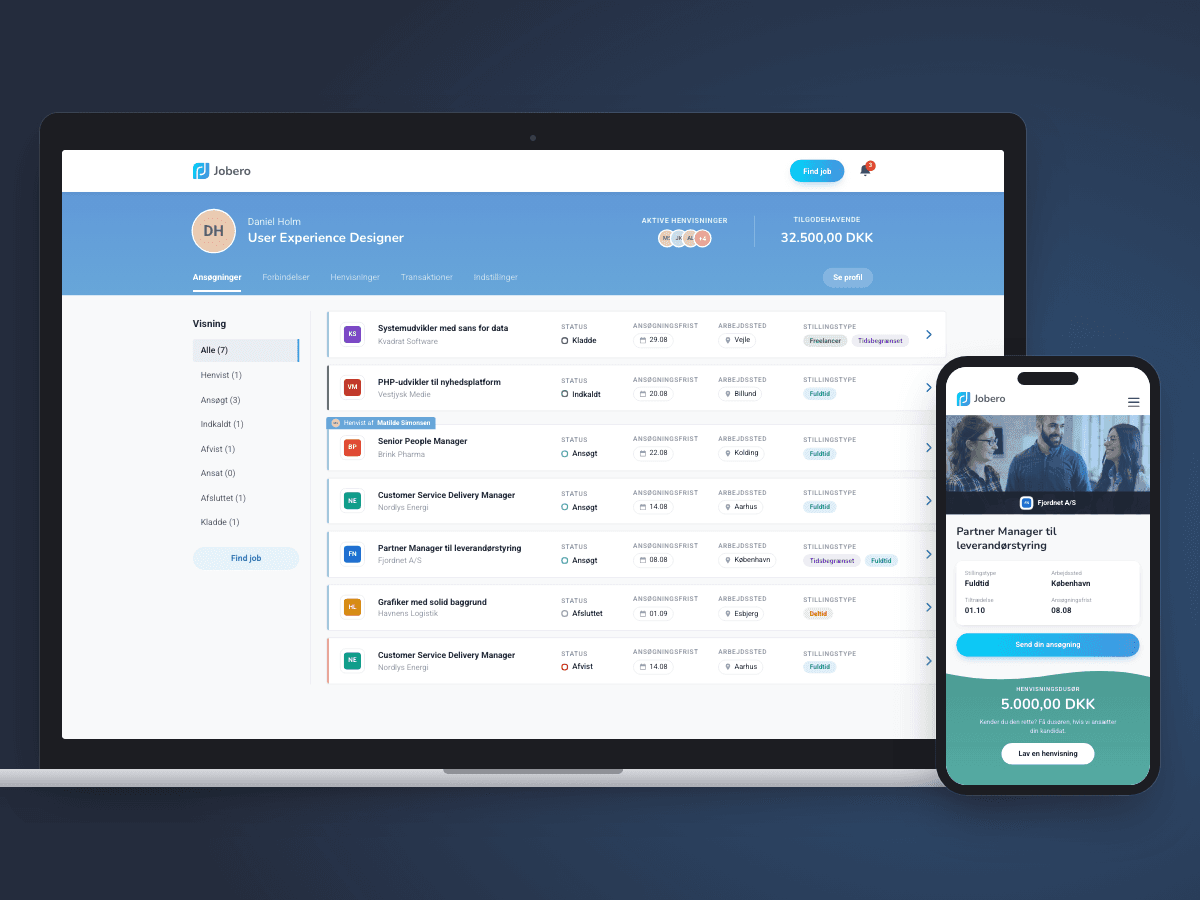
The first step is plain MVP development: the smallest product someone will pay for. Jobero is an example of a product we built from the first sketch – brand, design and the full system.
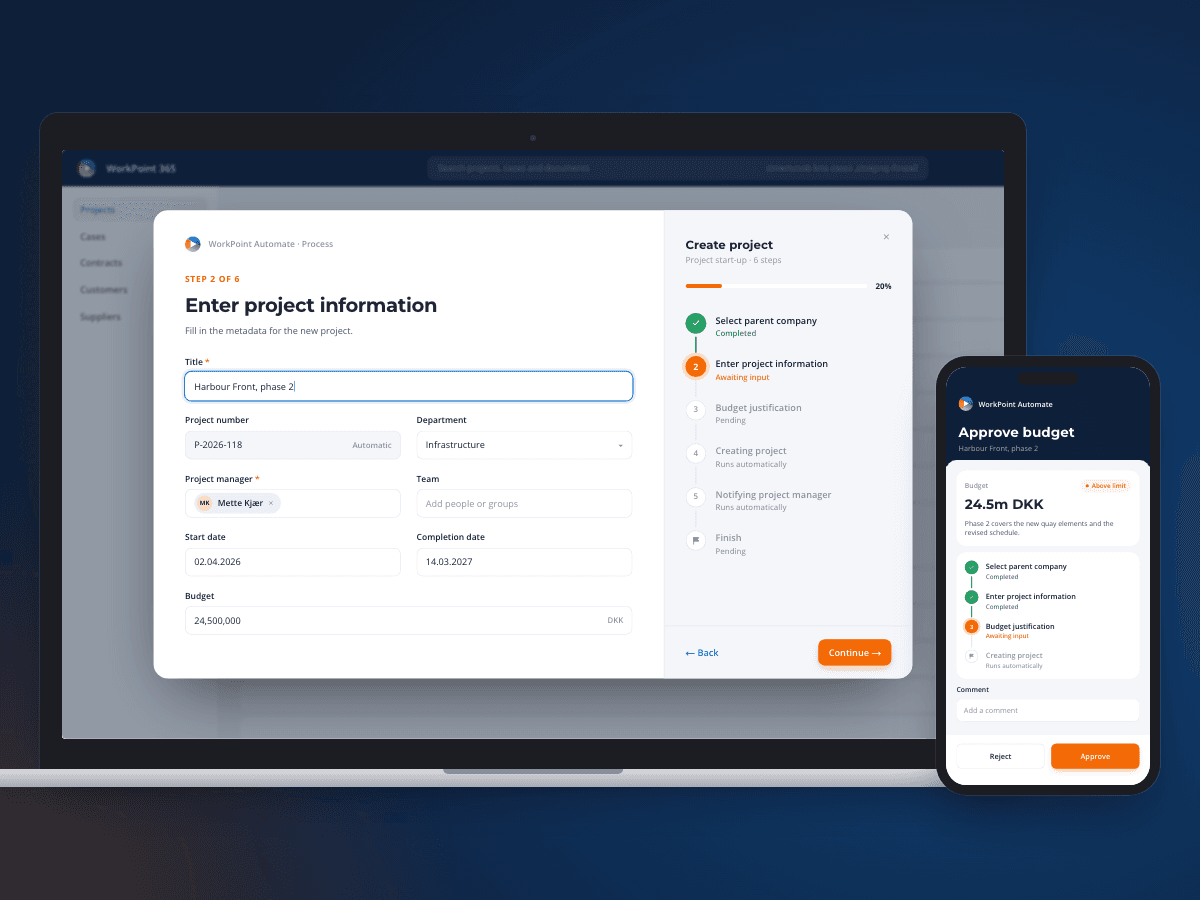
As the product grows, design consistency matters more. For WorkPoint, which builds SaaS on Microsoft 365, we spent two years on Design System 2.0 across WorkPoint Core, Automate and Express 365, with a designer embedded in the product teams. See the WorkPoint case, and read what a design system does for a growing product.
Build everything first
- Months before the first customer
- Features based on guesses
- A big bill before validation
- Hard to change direction
Start with an MVP
- First customers within weeks
- Features based on real use
- A fixed price for version one
- Easy to adjust to feedback
What should you pin down before building a SaaS?
- Who is the customer: a business with several users or a single person?
- The pricing model: a flat monthly fee, per user or usage-based?
- What customers get during the trial, and what happens when it ends?
- Which data you process on customers’ behalf – and whether a data processing agreement is ready
- Which integrations customers expect on day one, and which can wait?
The pricing model is the one most often forgotten, and it affects both the data model and the Stripe setup. Deciding it before we build saves you migrating subscribers later. If you sell to Danish businesses, many will also ask about GDPR and hosting before they sign – so it is worth having the answers ready when the first sales meetings begin.
How much does SaaS development cost?
A SaaS MVP with login, a core flow and Stripe typically fits Small or Medium: DKK 18,000 plus DKK 600 a month with 12 features, or DKK 36,000 plus DKK 900 a month with 24. With Stripe, e-conomic and, say, HubSpot you are in Large: DKK 54,000 plus DKK 1,200 a month and three integrations. For comparison, MVPs typically cost DKK 45,000–150,000 at smaller Danish studios. After launch we add features at a fixed price per extra feature. See pricing.
What our clients say
We have worked with Ceptiv on several of our digital offerings, and they have become a natural part of the team. They move fast, turning ideas into new designs and clickable prototypes quickly, so we can test with customers early instead of debating on paper.
FAQ
Questions about SaaS development
How much does it cost to build a SaaS?
What is multi-tenant?
Why Stripe for SaaS subscriptions?
How long does a SaaS MVP take?
Who owns the SaaS platform?
Can we get an app for our SaaS?
Tell us what you need built
You get a written fixed-price proposal within 24 hours. No sales calls required.