React Native app development: one app for iOS and Android
The short answer: with React Native we build one app that runs as a real app on both iPhone and Android, from a single shared codebase. Our app packages start at EUR 4,000 plus EUR 165 a month for hosting and upkeep, and you get a written fixed-price proposal within 24 hours.
- 1
- Codebase for iOS and Android
- 40+
- Pre-built integrations, e.g. MobilePay and MitID
- 24
- Hours to a written fixed-price proposal
When you need an app for iOS and Android, the biggest question is rarely the design. It is whether you pay for two apps or for one. With React Native we write the app in TypeScript and React, and the same code becomes a native app on both platforms, with real controls, navigation and access to the camera, GPS and push. It is the stack behind all of our mobile apps. Below you will find what it costs, when it is the wrong choice, and how the app actually reaches the stores.
28.000 kr
Small app package, one-time (EUR 4,000)
24 t
To a written fixed-price proposal
40+
Pre-built integrations
What is React Native, and why one codebase?
React Native is an open-source framework from Meta. Instead of writing the app twice, in Swift for iPhone and Kotlin for Android, we write the logic, screens and data flow once. The result is not a website wrapped in an app shell. It is native components that look and behave the way people expect on their phone. For you that means one supplier, one codebase to maintain, and new features that land on iOS and Android on the same day instead of one platform always lagging behind.
How much does a React Native app cost?
Our app packages. Same price whether the app ships on iOS, Android or both.
| Package | One-time | Per month | Scope |
|---|---|---|---|
| Small | EUR 4,000 | EUR 165 | 12 features, 1 integration |
| Medium | EUR 6,500 | EUR 250 | 24 features, 2 integrations |
| Large | EUR 10,000 | EUR 325 | 36 features, 3 integrations |
For comparison, typical market ranges in Denmark are 50.000–150.000 kr for a simple app, 150.000–500.000 kr for a medium one and from 500.000 kr to over 1 million kr for a complex app. Cross-platform typically saves 30–40 % compared with two separate native apps, and many budget 15–20 % of the build cost per year for maintenance. With us, the monthly fee covers hosting, updates, support, security and backups. The full breakdown is in how much does an app cost, and the packages are on pricing.
When is fully native still the right call?
React Native fits
- Booking, orders, customer portals and internal tools
- Login, lists, forms, payments and push
- Camera, barcode scanning and GPS
- The same app must ship on iOS and Android on one budget
Fully native may be better
- Heavy 3D games and advanced graphics
- Apps built tight to new hardware, such as special sensors
- One platform only, and an in-house team already writing Swift
- Widgets and watch apps as the core product, not an add-on
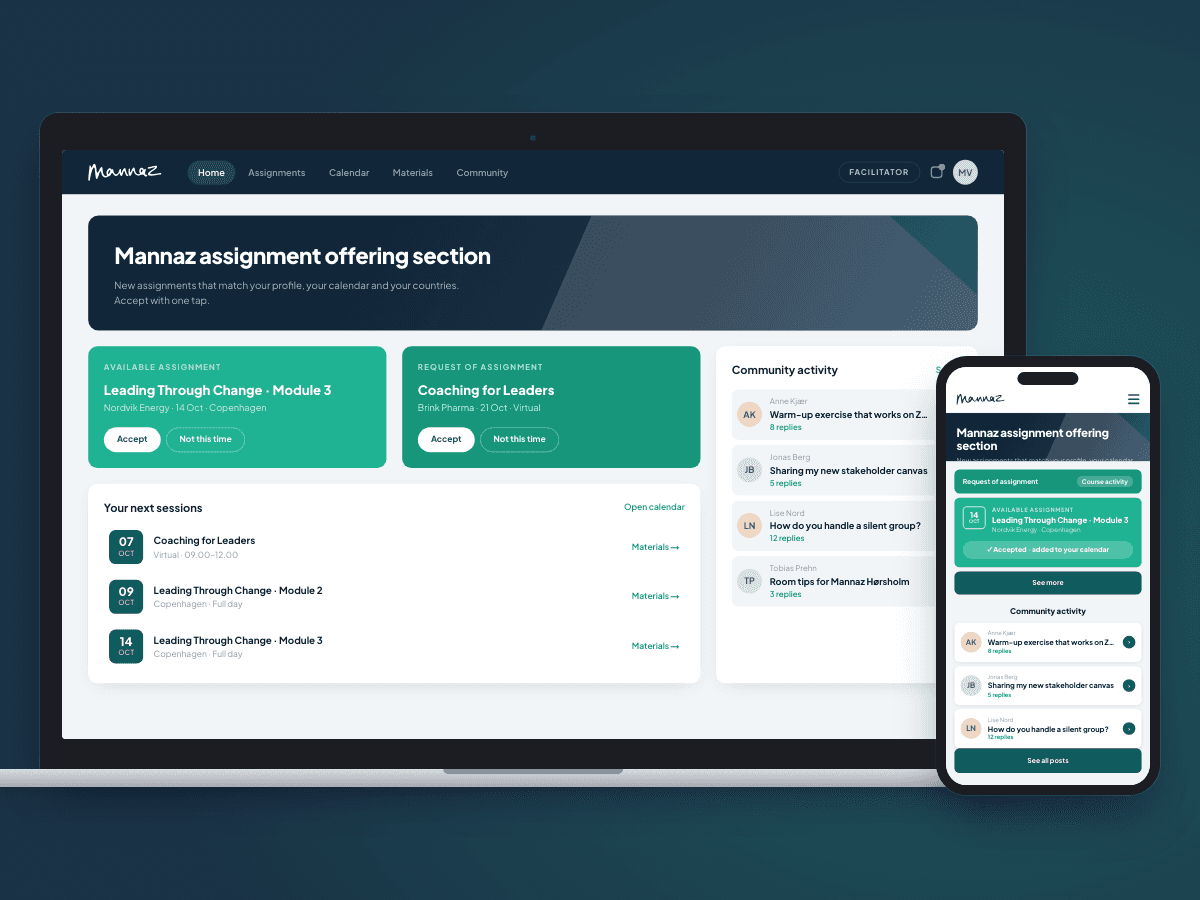
And sometimes the answer is neither React Native nor native, but a web app. If your users mostly sit at a computer, or you do not need push and an App Store presence, a web app is cheaper and faster to change. We walk through that choice in web app vs native app. MyMannaz is a good example: one web app that brings coordinators, facilitators and participants together, without anyone downloading anything from a store.
Push, offline and login: what makes an app an app
- Push notifications for reminders, status changes and new messages, controlled from your own admin panel
- Offline mode, so field staff can record data without signal and sync afterwards
- Login with email, Apple, Google or MitID when you need to know exactly who the user is
- Payments with MobilePay, Stripe or QuickPay inside the app
- Camera and scanning for receipts, barcodes and labels
- Integrations with e-conomic, Dinero, HubSpot or your own system, so nobody types the same data twice
Offline is the feature that gets underestimated most often. An app that freezes in a basement or on a building site is quickly abandoned. So we design the data model to save locally first and send when the connection returns, with a clear signal to the user about what has synced.
How the app gets into the App Store and Google Play
Developer accounts
You open accounts with Apple (99 USD a year) and Google (25 USD once) in your own name.
Test build
You test the app on your own phones via TestFlight and Google internal testing before any customer sees it.
Store listings
We prepare screenshots, copy and the privacy details Apple and Google require.
Review and launch
We submit, respond to any rejections and launch on both platforms.
After launch, updates follow the same route. New iOS and Android versions arrive every year, and keeping the app compatible is part of the monthly plan. Small copy and content fixes can often ship without a new store review.
What we have built for mobile
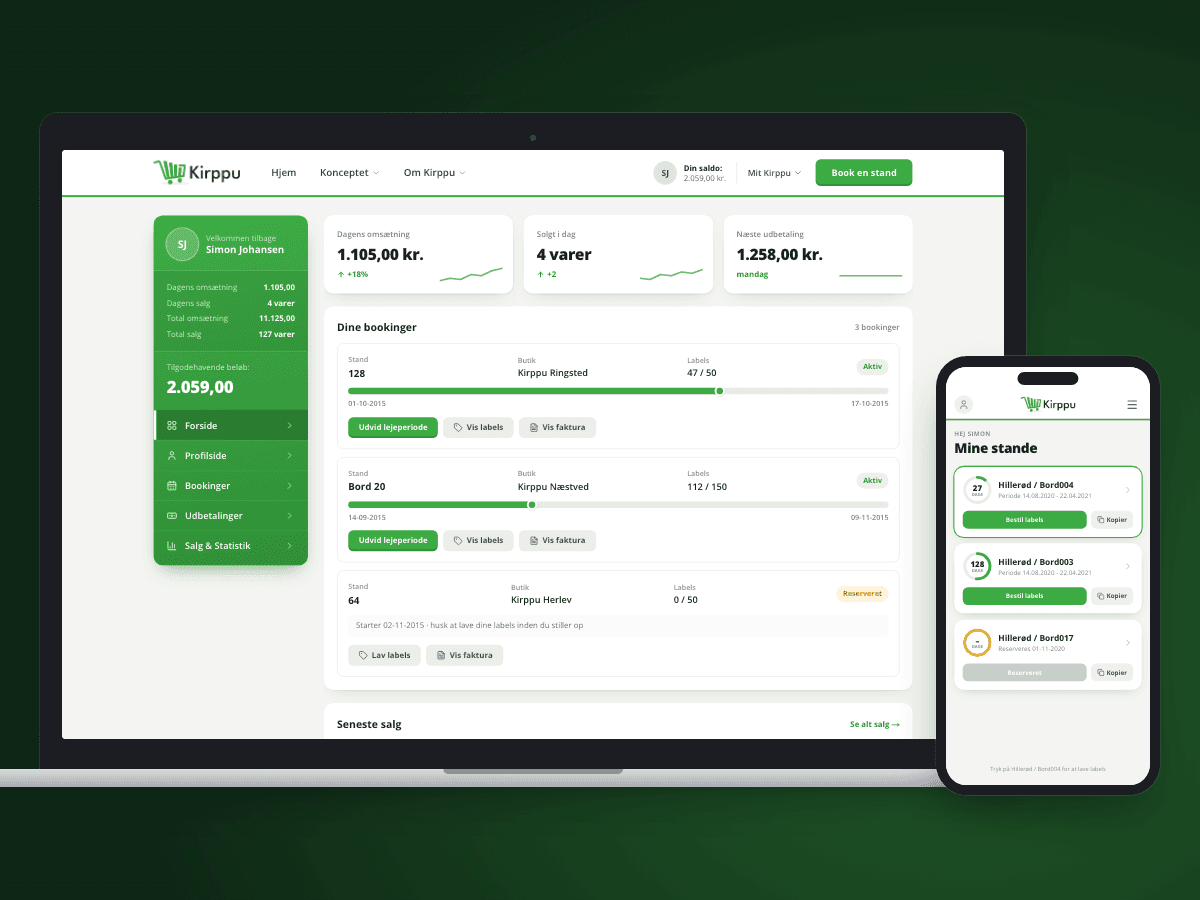
For Kirppu, the booking system behind Denmark’s largest chain of flea market supermarkets, we built stand booking, a renter panel and a mobile label app. The platform grew from one store to more than 30 stores. That is typical of the apps we build: a concrete task that has to be quick in the hand, wired to a system behind it that runs the data and payments.
What our clients say
We have worked with Ceptiv on several of our digital offerings, and they have become a natural part of the team. They move fast, turning ideas into new designs and clickable prototypes quickly, so we can test with customers early instead of debating on paper.
FAQ
FAQ: React Native app development
Is a React Native app a real app?
What does a React Native app cost with you?
Can the app work without internet?
Who owns the app and the code?
Should we choose a web app or an app?
How long does it take to build an app?
Tell us what you need built
You get a written fixed-price proposal within 24 hours. No sales calls required.